


Introduction: The Two Cups That Started a Thousand Arguments
There’s a particular kind of paralysis that hits you in a kitchen store when you’re staring at a wall of coffee equipment, wallet in hand, no idea what you actually need. Two items always dominate that wall: the French press — sturdy, cylindrical, satisfyingly mechanical — and the pour-over dripper, elegant in its simplicity, promising a cup that tastes like the coffee actually wanted to be brewed that way.
I’ve made both methods my daily driver at different points. Spent months with a French press on the desk, convincing myself the sludge at the bottom was “character.” Then switched to pour-over and spent an embarrassing amount of time watching YouTube tutorials on pouring technique as if I was learning surgery. Both cups were worth it. Both methods taught me something the other couldn’t.
This guide is for everyone who’s typed some version of “pour-over vs French press which is easier” into a search bar and got back a wall of jargon about extraction ratios and bloom times. We’re going to cover all of it — but in plain language, with honest takes on what’s actually hard and what’s actually rewarding about each method.
Key Takeaways
- French press is significantly easier for beginners — it requires no special pouring technique, tolerates grind inconsistencies better, and has a nearly zero learning curve.
- Pour-over produces a cleaner, brighter cup with more flavor clarity — but rewards practice and the right equipment.
- Both methods use similar coffee-to-water ratios (roughly 1:15 to 1:17) and brew in about the same total time.
- Grind quality matters more for pour-over than for French press — investing in a burr grinder makes a bigger difference for pour-over.
- The “best” method is genuinely personal — it depends on what kind of cup you love, your morning routine, and how much you enjoy the ritual.
What Is French Press Coffee? (And Why Do People Love It So Much)
The French press — also called a cafetière in British English, or a press pot in specialty coffee circles — is an immersion brewing method. You add coarsely ground coffee to the glass carafe, pour hot water over it, let everything steep together for about four minutes, then press a metal mesh plunger down to separate the grounds from the liquid.
That’s genuinely the whole process.
What makes French press coffee distinctive is what the metal mesh doesn’t remove: the natural oils from the coffee bean, and very fine particles of ground coffee that slip through the mesh. These elements give French press coffee its signature character — full-bodied, rich, heavy on the palate, with what coffee professionals call “mouthfeel.” It’s a thick, bold, almost chewy cup that espresso drinkers often gravitate toward.
The downside? That same lack of filtration means you’ll find sediment at the bottom of your cup. Fine grounds that made it past the plunger settle there as you drink. Most experienced French press drinkers simply stop pouring when they reach the last centimeter of liquid, leaving the sludge behind. It’s a minor adaptation that quickly becomes habit.
A brief history worth knowing
The French press was patented in France in 1929, though its origins are murkier than that — an Italian designer named Attilio Calimani filed a patent in 1929, and several design refinements followed over the decades. The version most people recognize today was largely standardized by the Danish manufacturer Bodum in the 1970s. It is, by most accounts, one of the most enduring coffee gadget designs in history. There’s a reason it hasn’t changed much in 50 years.
What Is Pour-Over Coffee? (And Why Does Everyone Seem So Serious About It)
Pour-over is a percolation brewing method, which is a fancy way of saying the water passes through the coffee grounds rather than steeping together with them. You place a paper (or metal) filter in a cone-shaped dripper, add medium-fine ground coffee, and pour hot water over the grounds in a controlled, deliberate way. The brewed coffee drips through the filter and into a cup or carafe below.
The paper filter catches everything the French press lets through — all the oils, all the fine particles. What you get is a remarkably clean, clear cup of coffee where individual flavor notes — fruit, floral, chocolate, whatever the bean carries — come through with much greater definition. Pour-over is often described as the best way to appreciate a high-quality, single-origin coffee bean, because nothing is masking or muting what’s in the cup.
The catch is that this clarity is also unforgiving. If your grind is off, you’ll taste it. If your pour is too fast, the water rushes through without fully extracting the coffee. Too slow, and you over-extract, getting a bitter, astringent result. The method rewards attention and practice.
The gear ecosystem
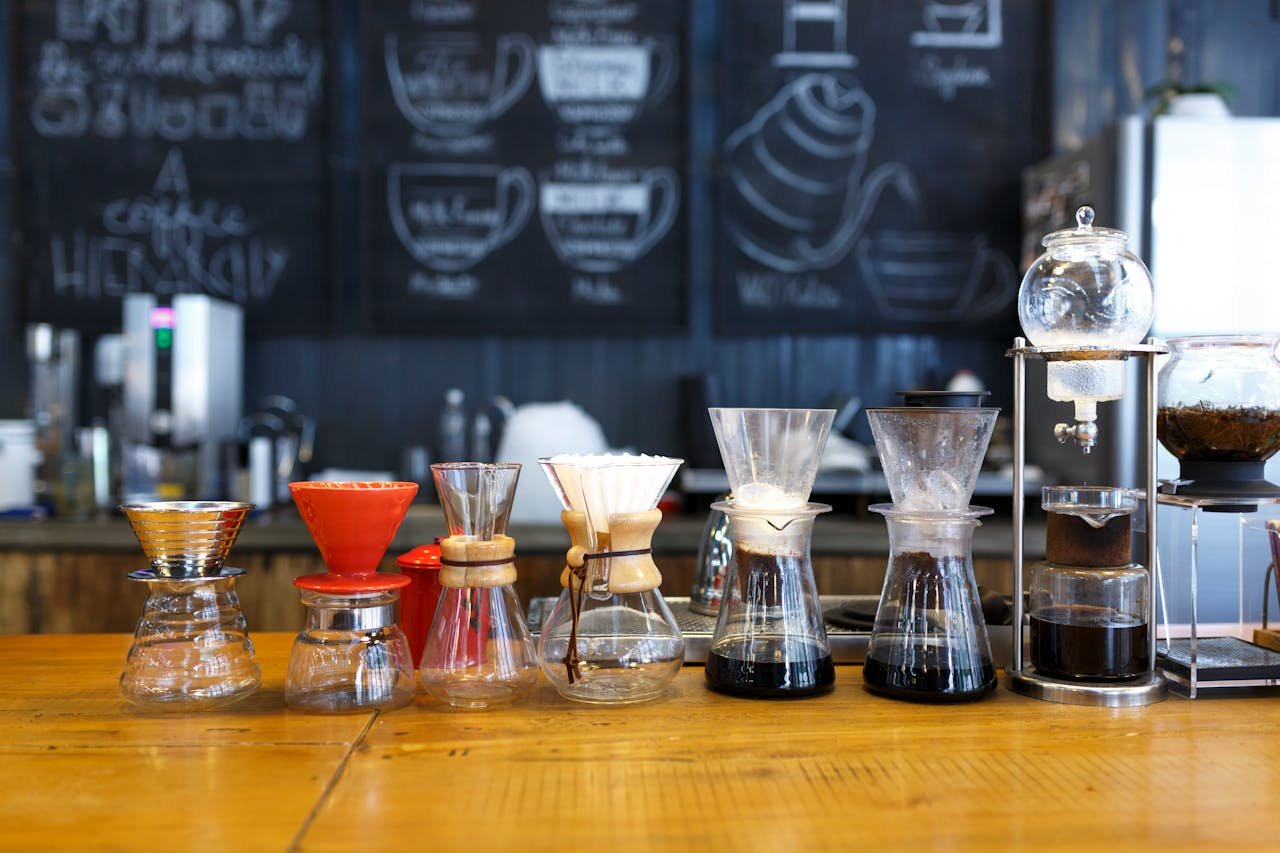
Unlike the French press — where a $20 Bodum is essentially as good as a $60 one for the average drinker — pour-over has spawned an entire premium equipment ecosystem. The Hario V60, Chemex, Kalita Wave, and Origami dripper are all pour-over devices with genuinely different properties. A gooseneck kettle (thin-spouted for precise, controlled pouring) is strongly recommended rather than optional. A kitchen scale is highly advisable for consistent results.
None of this is strictly required to make a decent cup. But the pour-over community tends to be… enthusiastic about equipment. You’ve been warned.
Head-to-Head Comparison: The Numbers
Here’s how the two methods stack up across the metrics that actually matter day-to-day:
How to Make French Press Coffee: Step-by-Step
This is genuinely one of the most forgiving brewing processes in coffee. Here’s the method that consistently produces a great cup:
What you need:
- French press (any size — 350ml, 600ml, 1L)
- Coarsely ground coffee (think sea salt texture, not table salt)
- Hot water just off the boil — around 93–96°C (200–205°F)
- A timer (your phone works fine)
The process:
- Preheat the press. Pour a little hot water in, swirl, discard. This keeps your brew temperature stable and isn’t strictly essential — but it matters on cold mornings.
- Add your coffee. The standard ratio is 1:15 — so for a 350ml French press, use about 23 grams of coffee (roughly 3 tablespoons). Adjust to taste; this is a starting point, not a law.
- Start your timer and add water. Pour hot water (off the boil, or around 93°C) over the grounds until they’re fully saturated. Give it a brief stir to make sure all the grounds are wet.
- Put the lid on, plunger up, and wait. Four minutes is the gold standard. Three minutes gives you something lighter and slightly underdeveloped. Five minutes pushes toward bitterness. Set that timer.
- Press slowly. Apply steady, even pressure on the plunger. If it resists heavily, your grind is too fine. If it drops with zero resistance, your grind is too coarse. A gentle, consistent 20–30 seconds is ideal.
- Pour immediately. Don’t let brewed coffee sit on the grounds — it will over-extract and turn bitter within minutes. Pour into cups or a thermal carafe right away.
Insider tip: The most common French press mistake isn’t the grind or the ratio — it’s leaving the coffee in the press after brewing. Even with the plunger down, extraction continues. Pour everything out the moment it’s done.
How to Make Pour-Over Coffee: Step-by-Step
Pour-over has more moving parts, but the logic behind each step is clear once you understand it. I’d encourage not skipping the bloom — it makes a real difference.
What you need:
- Pour-over dripper (Hario V60, Chemex, Kalita Wave, or similar)
- Paper filter (or a reusable metal filter)
- Medium-fine ground coffee (finer than sea salt, coarser than espresso — table salt consistency)
- Gooseneck kettle (strongly recommended, not strictly required)
- Kitchen scale (highly recommended)
- Hot water at 90–96°C (195–205°F)
The process:
- Rinse the filter. Place your paper filter in the dripper and pour hot water through it before adding coffee. This removes the papery taste and preheats the dripper and cup below. Discard the rinse water.
- Add your coffee. A 1:15 to 1:16 ratio works well for most pour-overs — for a 300ml cup, use about 18–20 grams of coffee.
- The bloom pour. Start your timer. Pour twice the weight of coffee in water (so 36–40ml for 18–20g of coffee) slowly and evenly over the grounds. You’ll see them bubble and expand — this is CO₂ releasing from fresh coffee. Wait 30–45 seconds. This step is called the bloom, and it’s the secret weapon pour-over has over French press for fresh beans.
- Continue pouring in slow circles. Pour the remaining water in slow, steady spirals from the center outward, keeping the water level consistent. Avoid pouring directly on the filter walls — you want the water passing through the coffee bed, not around it.
- Total brew time target: 3–4 minutes. If it’s draining faster, your grind is too coarse. Slower than 4 minutes? Too fine. Grind adjustment is the primary troubleshooting tool in pour-over.
- Remove the dripper and enjoy. Clean cup, no sediment, ready to drink.
Insider tip: Water temperature matters more in pour-over than French press. With lighter roasts, go a touch cooler — around 88–92°C — to avoid over-extracting the more delicate compounds. With darker roasts, go hotter (93–96°C) since the compounds are less soluble after roasting.
The Grind: The Single Biggest Variable in Both Methods
If I had to identify the one thing that separates good home coffee from great home coffee, it’s grind quality and consistency. A blade grinder — the cheap spinning disc type — chops coffee into irregular fragments of all sizes. Some extract fast, some extract slowly, and the result is a muddled cup.
A burr grinder crushes coffee between two abrasive surfaces set at a precise distance, producing uniform particles of consistent size. The difference in the cup is not subtle.
For French press: A blade grinder is tolerable because the coarse grind required means fewer fine particles are produced and the forgiving immersion method smooths over inconsistencies somewhat. Still, a burr grinder improves results noticeably.
For pour-over: A burr grinder is almost non-negotiable if you want consistently good results. The medium-fine grind required means blade grinder inconsistency directly affects extraction and cup quality. This is the single best equipment upgrade a pour-over brewer can make.
Budget burr grinders start around $30–40 (Timemore C2, Hario Mini Mill) and make a significant difference. You don’t need to spend $200 to see major improvement.
Water Temperature: More Important Than Most People Think
Both methods perform best with water that’s just off a full boil — not boiling, and not tap-warm. The ideal range of 90–96°C exists because:
- Boiling water (100°C) over-extracts certain bitter compounds, particularly chlorogenic acids
- Water below 88°C under-extracts and produces flat, weak, sour-tasting coffee
- The 4–6°C window in between extracts sugars and acids in the right balance
If you don’t have a temperature-controlled kettle, a practical rule of thumb: boil the water, then let it sit for 30–45 seconds before pouring. That typically drops it to the right range.
For French press, this is somewhat more forgiving since the water cools slightly during the 4-minute steep. For pour-over, temperature accuracy matters more because the contact time per pour is so brief.
Coffee Bean Selection: Which Roast Works Best for Each Method?
This is where the two methods genuinely diverge in terms of what they’re best suited for.
French press shines with medium to dark roasts. The heavy body and natural oils of the French press cup pair naturally with the deeper, more developed flavors of darker roasts — chocolate, caramel, nuts, smokiness. The sediment and richness of the brew can overwhelm the delicate, fruit-forward qualities of a light roast.
Pour-over is the method of choice for light and medium-light roasts. Specialty coffee roasters often specifically note that their single-origin light roasts are “best brewed as pour-over.” The clean filtration preserves floral notes, berry acidity, and subtle sweetness that get buried in a French press brew.
That said — rules are made to be bent. I’ve had wonderful French press cups with a washed Ethiopian natural processed light roast, and perfectly good pour-overs with a dark Sumatran. Experiment. The above is guidance, not doctrine.
Cleanup: The Unglamorous but Genuinely Important Comparison
Nobody talks about cleanup when they romanticize coffee brewing rituals. They should.
French press cleanup involves rinsing the grounds out of the metal mesh — which sounds simple until you realize wet coffee grounds have an uncanny ability to clog drains and scatter across your sink. The standard technique is to fill the press halfway with water after use, swirl, and dispose of the grounds in a bin or compost. The mesh plunger needs to be periodically disassembled and properly cleaned or it develops oils that turn rancid.
Pour-over cleanup is legitimately easier day-to-day: remove the paper filter (with grounds inside), fold it over, bin it. Rinse the dripper. Done in thirty seconds. The gooseneck kettle needs descaling occasionally. That’s about it.
This sounds like a minor point until you’re running late on a Tuesday morning and staring at a French press full of used grounds. The pour-over’s paper filter suddenly seems like a quiet act of mercy.
Which One Should You Actually Buy?
Here’s the honest answer to the question everyone’s really asking:
Buy a French press if:
- You’re new to specialty home brewing and want a low-barrier, high-reward starting point
- You prefer a bold, rich, full-bodied cup of coffee
- You mostly drink medium or dark roasts
- You don’t want to buy additional equipment (no scale, no gooseneck kettle required)
- You want to spend under $30 and get something that works perfectly well for years
Buy pour-over equipment if:
- You already have or plan to buy a decent burr grinder
- You’re interested in tasting the nuances in lighter, single-origin specialty coffees
- You enjoy the morning ritual of active brewing — something to focus on before the day begins
- You prefer a cleaner cup without sediment
- You’re willing to practice and iterate on your technique
Buy both if:
- You want different cups for different moods (genuinely a valid strategy)
- You have people over who want different coffee experiences
- You’ve read this article, nodded repeatedly, and already know you’re going to anyway
Frequently Asked Questions
Is French press coffee stronger than pour-over? Not necessarily in terms of caffeine — both use similar coffee-to-water ratios and extract similar amounts of caffeine per cup. French press tastes stronger because the oils and fine particles create a heavier, bolder mouthfeel. Pour-over can actually have slightly more caffeine per milliliter since paper filters don’t remove caffeine, but the difference is negligible in practice.
Can I use the same coffee beans for both methods? Yes, absolutely — you just need to grind differently. Coarse for French press (sea salt texture), medium-fine for pour-over (table salt texture). Most quality coffees work in both brewers; it’s the roast level and origin that determines which method shows them off best.
Why does my French press coffee taste bitter? The most common cause is leaving the coffee in contact with the grounds after pressing — pour it out immediately. The second most common cause is grinding too fine, which over-extracts. Third: water that’s too hot (boiling rather than just off the boil). Try a slightly coarser grind and a shorter steep time first.
Why does my pour-over coffee taste sour or weak? Sourness is almost always under-extraction — the water moved through the coffee too quickly to extract enough. The fix is a finer grind. You can also try slightly hotter water or a slower pour. If your brew time was under 2.5 minutes, grind finer.
Do I need a gooseneck kettle for pour-over? You don’t need one, but it genuinely helps. A regular kettle can work if you pour slowly and carefully, but controlling the flow rate is much harder. Gooseneck kettles start around $20–30 and are one of the most impactful pour-over upgrades you can make.
How much coffee should I use for French press? The standard ratio is 1:15 (coffee to water by weight). For a standard 350ml French press, that’s approximately 23 grams of coffee. For a 1-liter press, about 65 grams. Adjust based on your taste preference — stronger drinkers can go 1:12 or 1:13.
Does the quality of water matter? More than most people expect. Coffee is approximately 98% water, so water quality affects the cup significantly. Filtered tap water or bottled spring water produces noticeably better results than heavily chlorinated tap water. Distilled water is actually too pure — minerals help extraction — so stick with filtered or spring water.
Can pour-over coffee be made in advance? You can brew it into a thermal carafe and keep it for a couple of hours without significant flavor degradation. More than that and it begins to taste flat and stale. French press coffee, similarly, should be consumed within 20–30 minutes of brewing for the best experience.
Conclusion
Here’s my honest personal take after years of making both: I reach for the French press when I want something uncomplicated and comforting — a dark roast on a slow Sunday morning, nothing to think about, just press and pour. It’s the coffee equivalent of a worn-in armchair.
Pour-over is what I use when I want to actually taste the coffee — when I’ve bought something interesting from a specialty roaster and I want to know what it genuinely tastes like. The ritual of it matters to me too. Four minutes of quiet, deliberate pouring before a chaotic workday is, unexpectedly, a good way to collect your thoughts.
Neither is objectively better. They’re different tools for different cups and different mornings. But if you’re standing in a kitchen store right now, wallet in hand, asking which one to start with — put down the pour-over dripper, pick up the French press, and get brewing. You can always add the pour-over later. And you probably will.
This article reflects hands-on experience with both brewing methods over several years. Equipment recommendations are based on real-world use, not sponsorship.