


Choosing a family dog isn’t simply about picking the cutest breed. The best family dog is one whose energy level, temperament, size, grooming needs, and training requirements fit your household.
A dog that is wonderful for an active family with teenagers may be a terrible match for a family with toddlers and a small apartment. That’s why breed selection matters—but so does the individual dog’s personality and early socialization.
1. Golden Retriever — Best Overall Family Dog
If someone asks me to name one breed that consistently fits family life, the Golden Retriever is an easy answer.
Goldens are typically:
- Friendly
- Affectionate
- Social
- Intelligent
- Eager to please
- Good with children when properly trained and socialized
They also tend to enjoy being involved in family activities rather than sitting on the sidelines.
Best for: Active families who want a medium-to-large companion.
Watch out for: Shedding, grooming, and their need for daily exercise.
2. Labrador Retriever — Best for Active Families
The Labrador Retriever is another classic family choice.
Labs are generally playful, affectionate, trainable, and highly social.
They’re particularly good for families who enjoy:
- Walking
- Hiking
- Swimming
- Fetch
- Outdoor activities
Young Labs can be extremely energetic, though, so don’t expect a puppy to calmly entertain itself all day.
Best for: Families with an active lifestyle.
3. Cavalier King Charles Spaniel — Best Small Family Dog
If you want a smaller companion, the Cavalier can be an excellent option.
They’re generally:
- Affectionate
- Gentle
- Sociable
- Adaptable
- Happy to spend time with their people
They’re also easier to manage physically than a large breed.
Best for: Families wanting a small, affectionate companion.
Important: Cavaliers have some significant inherited health concerns, so choosing a responsible breeder or considering a reputable rescue is particularly important.
4. Beagle — Best for Fun-Loving Families
Beagles are cheerful, curious and playful.
They’re often wonderful family companions, but there’s one major caveat:
Their noses get them into trouble.
A Beagle may happily follow an interesting scent rather than listen to you calling it back.
Best for: Families that can provide exercise, supervision and consistent training.
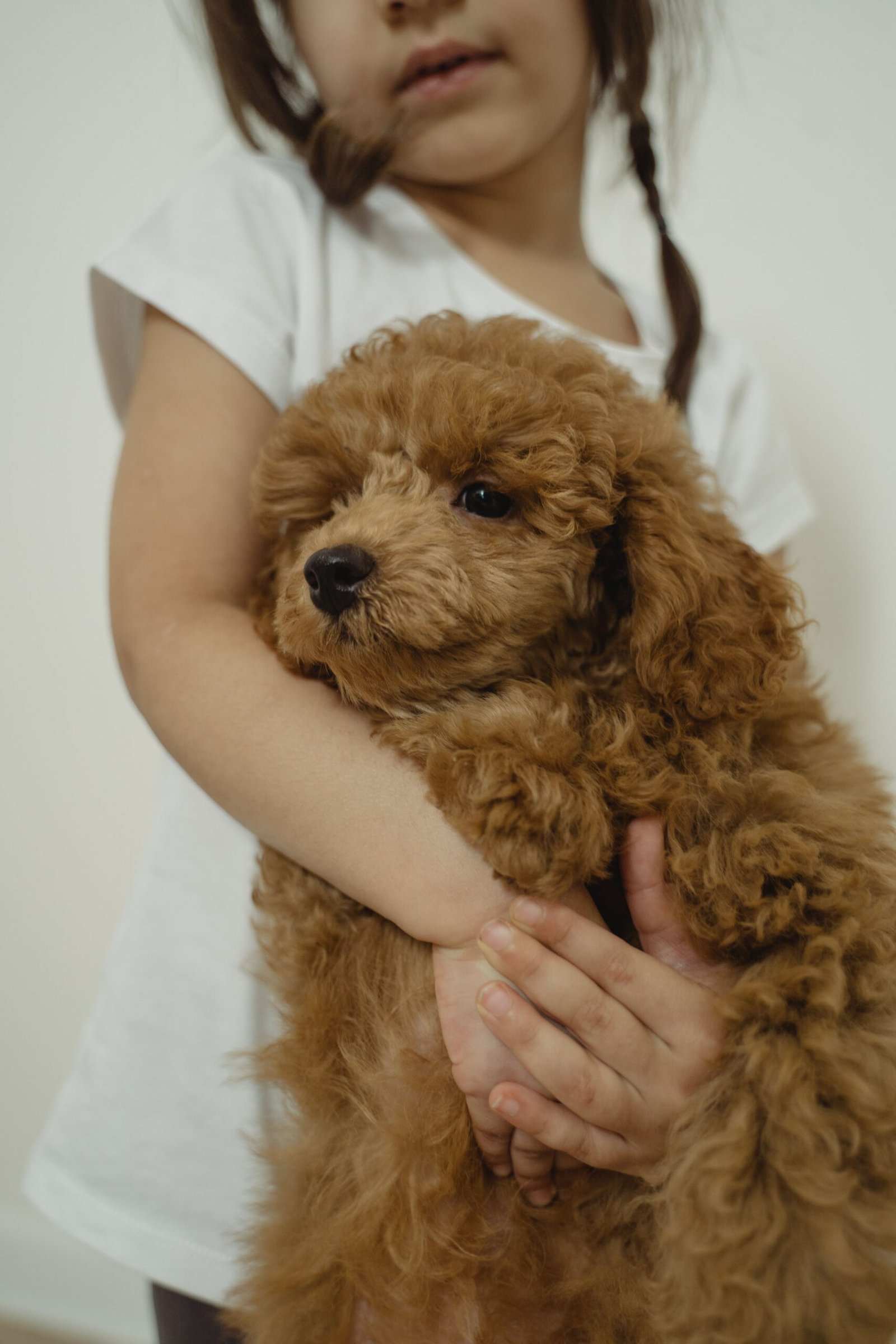
5. Poodle — Best for Intelligent Families
Poodles come in Standard, Miniature and Toy sizes.
They’re exceptionally intelligent and can be highly trainable.
Standard Poodles can make excellent family dogs for active households.
They also tend to shed less than many breeds, although no dog is completely hypoallergenic.
Best for: Families willing to invest time in training and grooming.
6. Newfoundland — Best Gentle Giant
The Newfoundland is enormous—but often remarkably gentle.
They’re known for being affectionate and patient, which has earned them a reputation as excellent family dogs.
Best for: Families with enough space for a very large dog.
Downside: Size, drooling, shedding and grooming.
7. Bernese Mountain Dog — Best for a Calm Family
Bernese Mountain Dogs are large, affectionate and generally calm when mature.
They often form strong bonds with their families.
They’re particularly appealing if you want a big dog with a relatively gentle temperament.
Best for: Families with space and time for a large companion.
8. Collie — Best for Trainability
Collies are intelligent, responsive and generally people-oriented.
They’re famous for their role as family dogs thanks in part to their gentle reputation.
They need regular mental and physical stimulation.
Best for: Families that enjoy training and outdoor activities.
9. Cocker Spaniel — Best Medium-Sized Companion
Cocker Spaniels can be affectionate, energetic and eager to participate in family activities.
They’re smaller than Labs and Goldens but still athletic enough for active families.
Best for: Families wanting a medium-sized dog with a friendly personality.
10. Boxer — Best for Playful Families
Boxers are energetic, affectionate and playful.
They often remain puppy-like for quite a while, which can be hilarious—and exhausting.
They need consistent training and plenty of exercise.
Best for: Active families with older children.
11. Irish Setter — Best for Very Active Families
Irish Setters are athletic, energetic and social.
If your family spends weekends hiking, running or exploring outdoors, an Irish Setter may thrive.
If everyone is looking for a couch potato, however, this probably isn’t your breed.
12. Bichon Frise — Best Small Apartment-Friendly Option
Bichons are small, cheerful companion dogs that can adapt well to smaller homes.
They generally enjoy human company and can be playful without requiring the exercise of a large working breed.
Best for: Families wanting a small dog.
Downside: Regular grooming is necessary.
13. Shih Tzu — Best for a Relaxed Household
Shih Tzus were bred primarily as companion dogs.
They can be affectionate and adaptable and generally don’t need the same level of exercise as sporting breeds.
Best for: Families looking for a smaller indoor companion.
14. Havanese — Best Social Small Dog
Havanese are friendly, affectionate companion dogs that often enjoy being around people.
They’re playful without typically requiring the enormous amount of exercise demanded by working breeds.
Best for: Families wanting a small, social companion.
15. Mixed-Breed Dogs — Often Overlooked
Don’t automatically assume you need a purebred dog.
A well-socialized adult mixed-breed dog from a reputable shelter or rescue can be an outstanding family companion.
One advantage of adopting an adult is that you can often get a better sense of the dog’s established:
- Personality
- Energy level
- Size
- Behavior around children
- Training level
For many families, that’s incredibly useful.
Best Family Dogs at a Glance
| Breed | Energy | Size | Family-friendly | Grooming |
|---|---|---|---|---|
| Golden Retriever | High | Large | ⭐⭐⭐⭐⭐ | Medium |
| Labrador Retriever | High | Large | ⭐⭐⭐⭐⭐ | Low–Medium |
| Cavalier | Moderate | Small | ⭐⭐⭐⭐⭐ | Medium |
| Beagle | High | Medium | ⭐⭐⭐⭐ | Low |
| Poodle | High | Varies | ⭐⭐⭐⭐⭐ | High |
| Newfoundland | Moderate | Giant | ⭐⭐⭐⭐⭐ | High |
| Bernese Mountain Dog | Moderate | Large | ⭐⭐⭐⭐⭐ | High |
| Collie | High | Large | ⭐⭐⭐⭐⭐ | Medium–High |
| Cocker Spaniel | Moderate–High | Medium | ⭐⭐⭐⭐ | Medium–High |
| Boxer | High | Large | ⭐⭐⭐⭐ | Low |
| Bichon Frise | Moderate | Small | ⭐⭐⭐⭐ | High |
| Shih Tzu | Low–Moderate | Small | ⭐⭐⭐⭐ | High |
What Makes a Good Family Dog?
Breed is only part of the equation.
When choosing a dog, I’d pay attention to these five things:
1. Temperament
Look for a dog that is generally:
- Stable
- Sociable
- Comfortable around people
- Not excessively fearful
- Responsive to handling
2. Energy Level
This is one of the biggest compatibility factors.
A high-energy dog needs daily physical and mental stimulation.
If your family prefers quiet evenings and short walks, don’t choose a breed designed to work for hours every day.
3. Size
Large dogs aren’t necessarily less gentle, but their size matters around small children.
Even a friendly 35-kg dog can accidentally knock over a toddler.
4. Grooming
Some dogs shed heavily. Others require professional grooming every few weeks.
Consider whether your family realistically wants that responsibility.
5. Training
Even a naturally friendly breed needs training.
A family dog should learn basic behaviors such as:
- Sit
- Stay
- Come
- Leave it
- Loose-leash walking
- Appropriate greeting behavior
Dogs and Young Children: An Important Rule
Never leave a young child and a dog unsupervised together, regardless of breed.
Even a gentle dog can react unexpectedly if it is frightened, injured, startled, or bothered while eating or sleeping.
Teach children:
- Don’t pull the dog’s ears or tail.
- Don’t climb on the dog.
- Don’t disturb it while eating.
- Don’t take its toys or food.
- Give it space when it retreats.
A responsible adult should supervise interactions.
What About Guard Dog Breeds?
Breeds such as German Shepherds, Rottweilers and Dobermans can be excellent dogs in experienced households, but they’re not automatically the best choice simply because you want protection.
They’re powerful, intelligent working dogs that require serious training and socialization.
For a typical family primarily looking for a friendly companion, a Golden Retriever, Labrador, Poodle, Collie or similarly temperamentally suitable breed may be a simpler match.
Best Family Dog by Lifestyle
🏡 Family with a large house and yard
Golden Retriever, Labrador, Collie, Bernese Mountain Dog
🏢 Apartment family
Cavalier, Bichon Frise, Havanese, Shih Tzu
🥾 Very active family
Labrador, Golden Retriever, Irish Setter, Poodle
👶 Family with young children
Focus on an individual dog’s temperament, supervision, and training rather than simply choosing a breed. Golden Retrievers, Labs, Cavaliers and well-socialized mixed-breed dogs can be good candidates.
👨👩👧 Family wanting a small dog
Cavalier, Bichon Frise, Havanese or Shih Tzu
🧠 Family that loves training
Poodle, Collie, Labrador or Golden Retriever
Key Takeaways
- Golden Retrievers and Labrador Retrievers remain excellent all-around family choices.
- Smaller breeds such as Cavalier King Charles Spaniels, Bichons and Havanese can work well for families wanting a smaller companion.
- Poodles are excellent for families that enjoy training and can commit to grooming.
- A dog’s individual temperament matters just as much as its breed.
- Young children should never be left unsupervised with any dog.
- Consider energy, size, grooming, training and health—not just appearance.
Frequently Asked Questions
What is the best dog breed for a family with children?
Golden Retrievers and Labrador Retrievers are among the most popular choices, but the best match depends on the children’s ages, your lifestyle, the dog’s temperament and your ability to provide training and exercise.
What is the best small dog for a family?
Cavalier King Charles Spaniels, Bichon Frises and Havanese can be good options. However, some very small dogs may be fragile around young children.
Are Golden Retrievers good family dogs?
Yes. Their generally social, trainable and affectionate nature makes them one of the most popular family breeds. They still require significant exercise, training and grooming.
Are Labradors good with kids?
Well-socialized Labradors can make excellent family companions. Young Labs can be boisterous, however, so supervision and training are especially important around small children.
Is adopting a dog better than buying one?
Neither is automatically better. A reputable breeder can provide health screening and predictable characteristics, while shelters and rescues can offer wonderful dogs—including adults whose personalities are already easier to evaluate.
Final Thought
The best family dog isn’t necessarily the breed with the longest list of “good with kids” reviews. It’s the dog whose needs your family can genuinely meet. A well-trained, appropriately socialized dog with a compatible temperament can become an incredible part of family life—but choosing a dog that doesn’t fit your household can make life difficult for everyone, including the dog.