



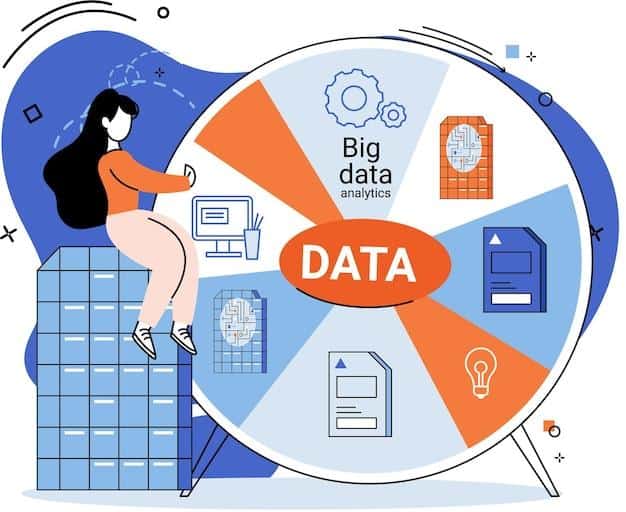
In today’s digital economy, businesses generate and process vast amounts of data every second. From customer interactions and sales transactions to supply chain operations and market trends, data has become a critical asset. Big data analytics plays a vital role in transforming this raw data into meaningful insights that support smarter, faster, and more accurate business decision making.
This article explores the role of big data analytics in business decision making, its benefits, applications, tools, and future impact across industries.
Understanding Big Data Analytics
Big data analytics refers to the process of examining large, complex datasets to uncover patterns, correlations, trends, and insights that traditional data processing methods cannot handle efficiently.
Big data is typically characterized by:
-
Volume: Massive amounts of data
-
Velocity: Rapid data generation and processing
-
Variety: Structured, semi-structured, and unstructured data
By applying advanced analytics techniques, businesses can turn data into actionable intelligence.
Why Big Data Analytics Is Critical for Business Decisions
Modern business decisions can no longer rely solely on intuition or historical experience. Competitive markets demand evidence-based strategies.
Big data analytics enables organizations to:
-
Identify emerging market trends
-
Understand customer behavior and preferences
-
Reduce operational inefficiencies
-
Minimize risks and uncertainties
-
Improve forecasting and planning accuracy
Data-driven decision making leads to higher efficiency, profitability, and long-term sustainability.
Key Roles of Big Data Analytics in Decision Making
Improving Strategic Planning
Big data analytics supports long-term planning by analyzing historical and real-time data. Businesses can evaluate past performance, predict future outcomes, and assess potential risks before making strategic decisions.
Executives can use analytics dashboards to compare scenarios and choose strategies backed by data rather than assumptions.
Enhancing Customer-Centric Decisions
Customer data is one of the most valuable resources for any business. Big data analytics helps organizations understand customer needs, preferences, and purchasing behavior.
This enables:
-
Personalized marketing campaigns
-
Improved customer retention strategies
-
Better product and service design
Customer-focused decisions driven by analytics result in stronger brand loyalty and higher conversion rates.
Optimizing Operational Efficiency
Operational decisions benefit greatly from real-time analytics. Businesses can identify bottlenecks, reduce waste, and streamline workflows.
For example, logistics companies use big data analytics to optimize delivery routes, while manufacturers use it to predict equipment failures and reduce downtime.
Supporting Financial and Risk Decisions
Big data analytics plays a crucial role in financial planning, budgeting, and risk management. By analyzing market trends, transaction patterns, and external economic factors, businesses can make informed financial decisions.
In technology-driven environments, analytics also supports innovation initiatives influenced by trends such as the Impact of 5G Technology on Smart Cities, where massive real-time data streams demand faster and more intelligent decision-making frameworks.
Big Data Analytics Tools and Techniques
The following table highlights common analytics approaches and their role in business decision making.
| Analytics Type | Purpose | Business Use Case |
|---|---|---|
| Descriptive Analytics | Understand past performance | Sales reporting |
| Diagnostic Analytics | Identify causes of outcomes | Root cause analysis |
| Predictive Analytics | Forecast future trends | Demand forecasting |
| Prescriptive Analytics | Recommend actions | Pricing optimization |
| Real-Time Analytics | Instant decision support | Fraud detection |
Using the right analytics type ensures decisions are aligned with business goals.
Industry Applications of Big Data Analytics
Big data analytics influences decision making across multiple industries.
-
Retail: Inventory optimization and personalized recommendations
-
Healthcare: Patient outcome prediction and resource planning
-
Finance: Fraud detection and credit risk assessment
-
Manufacturing: Predictive maintenance and quality control
-
Marketing: Campaign performance analysis and audience segmentation
Each industry leverages analytics to improve accuracy and speed in decision processes.
Challenges in Implementing Big Data Analytics
Despite its benefits, implementing big data analytics is not without challenges.
Common issues include:
-
Data quality and integration problems
-
High infrastructure and maintenance costs
-
Shortage of skilled analytics professionals
-
Data privacy and compliance concerns
Addressing these challenges requires proper governance, skilled teams, and scalable analytics strategies.
Future of Big Data Analytics in Business Decisions
The future of business decision making is increasingly automated and intelligent. With the integration of artificial intelligence and machine learning, big data analytics will move beyond insights to autonomous decision support.
Businesses that invest early in analytics-driven cultures will gain a competitive advantage by making faster, more accurate, and more adaptive decisions.
Frequently Asked Questions
What is the primary role of big data analytics in business decision making?
Its primary role is to transform large datasets into actionable insights that support data-driven decisions.
How does big data analytics improve decision accuracy?
By analyzing patterns and trends from large datasets, it reduces uncertainty and reliance on guesswork.
Can small businesses benefit from big data analytics?
Yes, scalable analytics tools allow small businesses to gain insights without large infrastructure investments.
What skills are required for big data analytics?
Key skills include data analysis, statistics, programming, and business understanding.
Is big data analytics only for strategic decisions?
No, it supports strategic, tactical, and operational decisions across all business levels.
Conclusion
The role of big data analytics in business decision making is essential in today’s data-driven world. By enabling organizations to analyze vast amounts of information, big data analytics empowers leaders to make informed, timely, and strategic decisions.
Businesses that embrace analytics not only improve efficiency and profitability but also build resilience and adaptability in an ever-evolving marketplace.