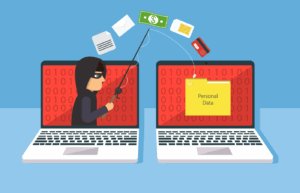




Small businesses are increasingly targeted by cybercriminals due to their often limited IT resources and less mature security infrastructure. Malware, ransomware, spyware, and phishing attacks can lead to data breaches, financial loss, and reputational damage. Choosing the best antivirus software for small businesses is critical to ensure comprehensive protection without disrupting daily operations.
This guide explores top antivirus solutions, key features, implementation strategies, and best practices to keep your small business safe.
Why Antivirus Software Is Essential for Small Businesses
Small businesses handle sensitive information such as:
-
Customer and client data
-
Financial records and invoices
-
Employee personal information
-
Intellectual property
-
Online transactions
A single malware infection can disrupt business operations and incur significant costs. Antivirus software provides real-time protection against threats, monitors system activity, and ensures safe web browsing, making it a cornerstone of small business cybersecurity.
Key Features to Look for in Antivirus Software
Selecting the right antivirus software involves evaluating several critical features.
| Feature | Description | Benefit for Small Businesses |
|---|---|---|
| Real-Time Protection | Monitors for malware and ransomware continuously | Reduces risk of infection |
| Firewall Integration | Blocks unauthorized network access | Enhances network security |
| Email Protection | Scans attachments and links | Prevents phishing attacks |
| Anti-Spyware & Anti-Adware | Detects malicious software and unwanted programs | Protects sensitive data and productivity |
| Centralized Management | Allows IT admin to manage multiple devices | Simplifies security monitoring |
| Automatic Updates | Ensures latest threat definitions are installed | Maintains effective protection |
| Low System Impact | Runs efficiently without slowing systems | Keeps employee productivity high |
Choosing software that balances protection, usability, and cost is essential for small businesses.
Top Antivirus Solutions for Small Businesses
1. Norton Small Business
-
Strengths: Cloud-based management, multi-device support, real-time threat detection
-
Best For: Businesses with remote or hybrid teams
2. Bitdefender GravityZone Business Security
-
Strengths: Advanced malware protection, anti-ransomware, endpoint control
-
Best For: Businesses seeking high-performance protection with minimal system impact
3. Kaspersky Small Office Security
-
Strengths: Easy setup, secure file encryption, backup integration
-
Best For: Small offices with limited IT support
4. Trend Micro Worry-Free Business Security
-
Strengths: Cloud-based management, phishing protection, behavior monitoring
-
Best For: Businesses that need quick deployment and simplified management
5. Sophos Intercept X for Small Business
-
Strengths: Endpoint protection, ransomware defense, AI threat detection
-
Best For: Tech-savvy teams requiring advanced AI-based threat detection
Benefits of Antivirus Software for Small Businesses
1. Real-Time Threat Detection
Prevents malware infections before they can cause damage.
2. Data Protection
Safeguards sensitive customer and financial information.
3. Regulatory Compliance
Helps meet data protection regulations such as GDPR, HIPAA, or CCPA.
4. Reduced Downtime
Prevents system crashes and malware-induced interruptions.
5. Simplified IT Management
Centralized dashboards make it easier to monitor security across multiple devices.
Best Practices for Using Antivirus in Small Businesses
Regular Updates
Ensure antivirus software and operating systems are updated to defend against emerging threats.
Centralized Management
Use cloud-based consoles to monitor and manage endpoints efficiently.
Employee Awareness
Train staff on safe internet practices, email security, and phishing detection.
Backup Critical Data
Maintain encrypted backups to ensure business continuity in case of malware or ransomware.
Layered Security Approach
Combine antivirus with firewalls, VPNs, and endpoint monitoring for enhanced protection.
Common Mistakes Small Businesses Make
-
Relying solely on antivirus without other security measures
-
Ignoring software updates and patches
-
Not training employees on cybersecurity awareness
-
Using consumer-grade antivirus for business endpoints
-
Overlooking mobile and remote devices in security coverage
Avoiding these mistakes improves overall cybersecurity posture.
How Antivirus Software Fits Into Cybersecurity Learning
For small business owners or IT staff looking to expand their expertise, understanding antivirus capabilities is a foundational step. Complementing practical experience with structured education is highly effective. Beginners can benefit from resources like Best Online Courses for Cybersecurity Beginners, which cover malware detection, network security, and endpoint protection strategies.
Future Trends in Antivirus Solutions
-
AI-Powered Threat Detection: Advanced artificial intelligence helps identify unknown malware and ransomware.
-
Cloud-Based Management: Simplifies monitoring multiple devices and remote endpoints.
-
Behavioral Analysis: Detects suspicious activity even when malware signatures are unknown.
-
Integrated Security Suites: Combines antivirus with endpoint protection, firewalls, and intrusion detection.
These innovations ensure that small businesses stay ahead of evolving cyber threats.
Frequently Asked Questions (FAQs)
1. Can antivirus software fully protect my business?
Antivirus provides essential protection but should be combined with employee training, firewalls, and endpoint security for comprehensive defense.
2. Is cloud-based antivirus better for small businesses?
Yes, cloud-based solutions simplify management, updates, and deployment for remote teams.
3. How many devices can small business antivirus cover?
Most solutions offer flexible plans ranging from 5 to 50 devices, with some scalable for larger teams.
4. Does antivirus slow down devices?
Modern solutions are optimized to minimize system impact while maintaining protection.
5. Should I use free antivirus software for my business?
Free software may offer basic protection but lacks enterprise features such as centralized management and ransomware defense.
6. How often should antivirus be updated?
Automatic updates are recommended to ensure real-time protection against the latest threats.
Conclusion
The best antivirus software for small businesses provides real-time malware detection, endpoint protection, and simplified management to defend against cyber threats. By choosing a solution that fits your team size, IT capabilities, and budget, businesses can minimize the risk of data breaches and operational downtime.